Using an Unregistered iPhone in Turkey (2026): IMEI, BTK Registration, 120-Day Rule and eSIM Reality
When you bring an iPhone from abroad and try to use it in Turkey, you quickly face IMEI registration requirements, the 120-day temporary usage rule, and regulations enforced by the Information and Communication Technologies Authority (BTK). With increasing registration fees and stricter controls in recent years, many users are asking a clear question: How does an iPhone without IMEI registration work in Turkey?
In this article, I examine the technical foundation of the IMEI system, its relationship with the iOS ecosystem, and the registration process implemented in Turkey. I also explain the functional limitations of an unregistered device and the technical logic behind temporary usage periods such as physical SIM and eSIM transitions.
The purpose is not to bypass any system, but to understand how the system technically operates.
IMEI System and Its Historical Development: The Evolution of Mobile Identity
With the development of mobile communication technologies, it has become inevitable for each device to have its own unique identifier. In this context, IMEI (International Mobile Equipment Identity) is a 15-digit numerical code that functions as the identity number of mobile phones. This number enables each mobile device to be uniquely identified on the network and provides detailed information about the device's technical specifications, manufacturer details, and authenticity. The primary function of the IMEI number is to ensure that the device's communication with mobile networks is secure and traceable. For example, if a device is stolen, it can be blacklisted via its IMEI number, preventing it from connecting to mobile networks even if a SIM card is inserted. This enhances user security and helps prevent mobile device theft. The origins of the IMEI system date back to the early 1990s, based on the GSM standard developed by the European Telecommunications Standards Institute (ETSI). Since then, it has been a significant step forward in terms of legal tracking of devices, manufacturer records, and government oversight mechanisms. Especially with the explosion in mobile device usage in the 2000s, the importance of IMEI has grown even more, becoming a critical element that encompasses not only communication but also device security, consumer rights, and data integrity.
THE IOS ECOSYSTEM AND IMEI RELATIONSHIP
Apple's iOS ecosystem is known for its closed and tightly controlled structure. This structure is specifically designed to maintain maximum system security and protect user data. The iOS operating system is only compatible with hardware produced by Apple, and this integrity makes it possible to control devices through their unique IMEI numbers. IMEI not only enables network access on iOS devices but also forms the basis for features such as iCloud activation lock and Find My iPhone. As a result, even if the IMEI of a stolen or lost device is known, it is nearly impossible for another user to reset and use it. However, this strict structure also brings certain limitations in terms of user freedom. iOS's closed-system approach does not allow for personal customizations on software or hardware; it only permits the use of apps approved by Apple. This situation may prevent iPhones brought from abroad and not yet registered with the BTK from being used effectively in Turkey. Because a device with an unregistered IMEI is limited to Wi-Fi when SIM card support is disabled; when combined with the closed nature of the iOS ecosystem, this significantly limits the user's control over the device. Apple's security-first approach protects users in many ways, while also strengthening the dependency between hardware and software. This removes the IMEI number from being merely a technical identifier and elevates it to the status of a digital key that ensures device security within the iOS ecosystem.
BTK's IMEI Registration System and Legal Processes in Turkey
The IMEI registration system implemented by the Information and Communications Technologies Authority (BTK) is of great importance for the legal and secure use of mobile devices in Turkey. This system aims to protect both consumer safety and the integrity of the communications infrastructure by requiring the registration of devices brought in from abroad. To use mobile phones brought from abroad in Turkey, their IMEI numbers must be registered in the BTK database. This process must be completed within 120 days of the device's entry into the country, along with the passport. The registration process is carried out through e-Government, and an annual fee must be paid. BTK also requires mobile operators (Turkcell, Vodafone, Türk Telekom) to share user device and SIM card information. This obligation is regulated under the Regulation on the Registration of Devices with Electronic Identity Information (2012/34) and Article 51 of the Electronic Communications Law No. 5809. This enables device-SIM pairing and allows unregistered or cloned devices to be detected and blocked from communication. These legal regulations ensure user safety and contribute to the healthy functioning of the national communications infrastructure. However, the complexity of the system and the high registration fees are sometimes criticized by users and lead to calls for improvement.
Table 1: IMEI Registration Fees by Year (₺)
Year | Registration Fee (₺)
— — — -| — — — — — — — — — — — -
2020 | 1,838.70 TL
2021 | 2,006.20 TL
2022 | 2,732.00 TL
2023 | 6,091.00 TL
2024 | 31,692.00 TL
2025 | 45,614.00 TL
User Experiences and Issues Encountered
Apple's iOS ecosystem stands out for its security-focused design and hardware-software integration. In this context, the IMEI number is physically embedded in the device's motherboard. Therefore, security vulnerabilities such as IMEI cloning, which can be encountered on Android devices, are technically impossible on iOS devices. While this provides iOS devices with a more robust structure in terms of IMEI security, the system's closed architecture also brings with it some unique challenges for users. When combined with the BTK's IMEI registration system, this closed structure causes various difficulties in terms of user experience. Especially for iPhones brought from abroad, the registration period being limited to 120 days makes it difficult for individuals visiting Turkey for a short period to use their devices legally. Additionally, the fact that the registration process can only be done using the passport of the person who brought the device creates a complicated process for users who wish to gift or transfer the device to another person. Incorrect information entered into the system, missing documents, or system errors can prevent users from completing the registration process, leading to grievances. Technical glitches, especially in the process carried out through the e-Government system, may result in users being unable to complete their registration requests by the deadline. iPhone devices that have not been IMEI registered can only operate with a Wi-Fi connection, which disables the device's basic communication functions. This restriction, combined with iOS's closed architecture, severely limits users' control over their devices. Users are unable to find individual solutions, and technical support requests sometimes remain unresolved due to insufficient information or guidance. In addition, device-SIM pairing through mobile operators can sometimes cause errors; for example, when a different SIM card is inserted, the device's access to the mobile network may be blocked. In such cases, support from customer service may not be sufficient, leaving users with uncertainty and a lack of information.
Applicable Solution Recommendations for Issues
IMEI Renewal via Motherboard Replacement (For iOS devices without IMEI registration, a legal matching method via hardware)
The motherboard is the main circuit board that acts as the brain of an iPhone device and connects all hardware components both physically and software-wise. In the iOS system, it not only contains the processing units but also the IMEI number representing the device's digital identity, encryption keys, and security controls. Apple's security-centric design includes layered protections not only at the software level but also at the hardware level. Thanks to this structure, some hardware components are cryptographically locked to the motherboard in a device-specific manner. In other words, the components are encrypted to work only on the motherboard they were manufactured on, and they are not recognized or become inoperable when installed on another motherboard. The basic components with this cryptographic matching are as follows:
· Face ID module (TrueDepth sensor array)
· Touch ID fingerprint sensor
· Main display panel
· Taptic Engine (vibration motor)
· Rear and front cameras
· Lightning or USB-C connection port
· Battery module
Therefore, when attempting to transfer a motherboard with a registered IMEI to an unregistered device, simply replacing the motherboard will not suffice. The above components with cryptographic ties must also be installed simultaneously with the original components belonging to the new motherboard. Otherwise, the device will not recognize these modules, and functions such as facial recognition, fingerprint recognition, and vibration may be completely disabled. This process involves the following steps:
1. From the donor device with a registered IMEI:
– Motherboard,
– Camera systems,
– Taptic Engine,
– Touch ID/Face ID unit,
– Screen and ports are carefully removed.
2. The hardware is removed from the unregistered device.
3. The donor parts are installed in the compatible device.
4. The device is reactivated using iTunes or Finder.
Any changes made must consider both physical compatibility and cryptographic encryption. Incorrect part matching can result in activation lock, Touch ID malfunction, or camera failure. Therefore, it is critical that users have these procedures performed only by specialized technical service providers using original Apple hardware parts. Otherwise, the device may experience software crashes or malfunctioning components.
Sharing Cellular Services Between Devices in the iOS Ecosystem (Enabling an iPhone without an IMEI registration to use basic communication functions through a registered iPhone)
Apple's iOS ecosystem, based on hardware-software integration, includes many built-in features that support device-to-device interaction and task sharing. One of these features, cellular service sharing, enables iOS devices paired with the same Apple ID to maintain communication functions even if one of them is not connected to a mobile network. When an iPhone device without an IMEI registration is unable to access mobile networks in Turkey, the user can transfer both call and SMS functions as well as cellular data functions to the unregistered device via a registered iPhone. This transfer is entirely software-based and does not require a physical SIM card transfer.
Step-by-Step Setup Process:
Both iPhone devices are logged in with the same Apple ID.
This enables device-to-device authorization through Apple's end-to-end encryption infrastructure.
Both devices connect to the same Wi-Fi network or enable Bluetooth connectivity between them.
Physical proximity is required for low-latency data transfer between devices.
The following settings are configured on the registered device:
- Settings > Phone > Enable the “Calls on Other Devices” feature.
- Settings > Messages > Select the second device with the “Forward Messages” feature.
Even if no SIM card is inserted in the unregistered device, after these settings:
- Calls can be made over the cellular network,
- SMS messages can be sent and received,
- Mobile data can be provided through a personal access point.
Systemic Advantages:
- The unregistered device can perform basic communication tasks.
- Calls and messages are routed securely thanks to Apple's secure protocols.
- The user experiences the device not just as a passive tool connected to Wi-Fi, but as an active communication device.
Limitations:
- If the physical and digital synchronization between the two devices is disrupted, the system will not function.
- Carrying two devices may be limiting in terms of battery consumption and practicality.
- The unregistered device still cannot communicate directly with service providers outside of Apple.
Enabling Cellular Communication with External SIM Adapters (Method for enabling calls, SMS, and data access on iPhones without IMEI registration using devices such as IKOS K7, MAG2SIM, and similar devices)
When iPhones without IMEI registration are blocked from accessing the mobile network in Turkey, users employ external SIM adapters to maintain communication functions without requiring hardware modifications. These devices enable the iPhone to recognize a registered SIM card via Bluetooth or Wi-Fi, thereby restoring the device's call, SMS, and mobile data functionality.
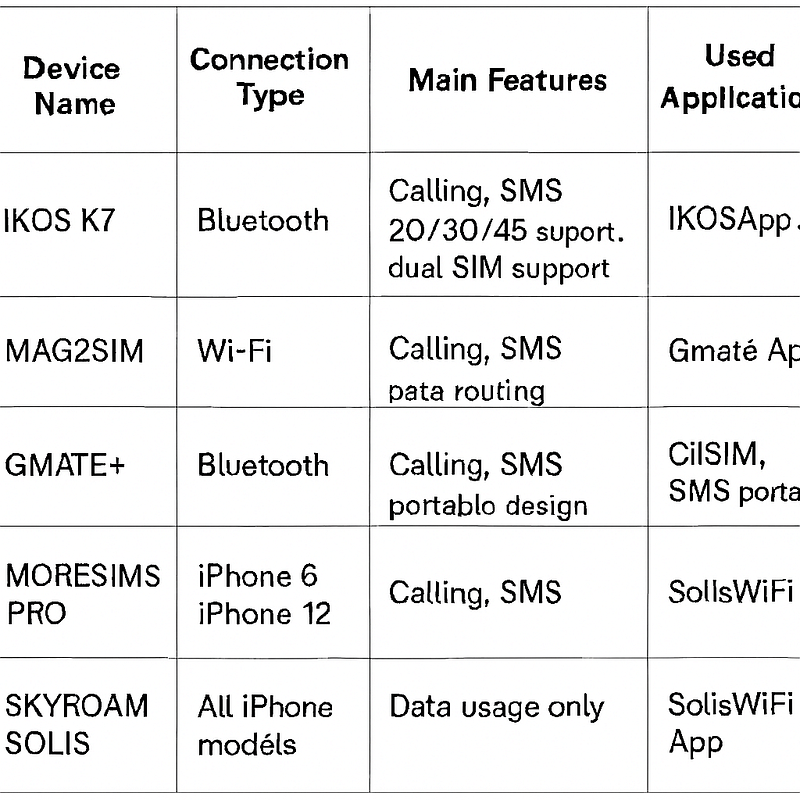
Installation and Usage Process (Step-by-Step Guide):
1. Charge and turn on the external device.
It is important that the device is fully charged for connection stability.
2. Insert a SIM card with a registered IMEI into the adapter.
This SIM card must be active and valid in the BTK system.
3. The manufacturer's app is installed on the iPhone.
For example: — For IKOS K7: *IKOS App*
- For MAG2SIM: *MAG2SIM App*
- For Gmate+: *Gmate+ App*
4. A Bluetooth or Wi-Fi connection is established.
The iPhone device is paired with the external adapter.
5. The SIM card is introduced and configured through the application.
Call, SMS, and data settings are managed from within the application.
6. Use begins.
Even if a physical SIM card is not inserted into the iPhone device, it performs mobile communication functions through the external device.
Advantages and Limitations
Advantages:
- Search, SMS, and data access are provided on devices without IMEI registration.
- No hardware intervention is required.
- It is portable and reusable.
- Some models offer dual SIM support.
- It can work independently with Apple ID.
Limitations:
- Communication is interrupted when the external device runs out of charge.
- The system does not work if the Bluetooth/Wi-Fi connection is lost.
- Additional hardware must be carried.
- Some applications (e.g., mobile banking) may be incompatible with this system.
- Call quality may vary depending on the hardware of the device used.
eSIM with 4+4 Day Extension and the Legal Framework in Turkey (A method to provide mobile access for a total of 240 days by switching between a physical SIM and eSIM on iPhones without IMEI registration)
iPhone devices that have not been registered with an IMEI number are granted temporary access to the mobile network for 120 days from the first SIM card registration under the system implemented by the Information and Communication Technologies Authority (BTK) in Turkey. At the end of this period, the device becomes “unregistered” and network access is terminated. However, users can obtain another 120-day period by switching between eSIM and physical SIM cards without any hardware intervention. This method allows an iPhone without IMEI registration to maximize the temporary usage rights offered by BTK in Turkey. However, these periods are only temporary solutions and do not replace permanent IMEI registration.
eSIM Activation: Application Steps
1- Obtain an eSIM-enabled iPhone device. (Compatible models are listed below.)
-All models from iPhone XR onwards (XS, 11, SE 2, 12, 13, SE 3, 14, 15, 16 series)
- iPhone models that can have two eSIM profiles active at the same time:
- iPhone 13 Pro and later
2- First, insert a physical SIM card into the device and use it actively for 120 days.
3- Around the 120th day, remove the physical SIM card and obtain a new eSIM profile through your mobile operator.
4-The following steps are followed on the iPhone:
- Settings > Cellular > Add Cellular Plan
- The QR code is scanned or the activation information is entered manually
- The eSIM profile is introduced to the device and the second 120-day period begins.
BTK's Legal Regulations on eSIM
- The use of eSIM in Turkey is limited to operator infrastructures approved by BTK (e.g., Turkcell, Vodafone, Türk Telekom).
- During each eSIM activation, TC identity verification is performed and the IMEI is matched and registered in the BTK system.
- BTK may restrict the creation of multiple temporary usage definitions for a device using the same IMEI number.
- Anonymous eSIM profiles originating from abroad may be blocked by the system.
Advantages
- Devices without IMEI registration can obtain legal network access for up to 240 days.
- No physical intervention or hardware changes are required.
- Offers flexibility to work with different operators.
- Enables quick operator switching when used abroad.
Limitations
- Durations cannot be extended; the device will be blocked again after a total of 240 days
- Number identifications may become confused in applications such as mobile banking
- eSIM support is only available on certain models
- BTK may refuse sequential temporary use when necessary
Number Assignment and Mobile Usage with Roaming-Based Global eSIM Services (A method of providing temporary mobile communication on iPhones without IMEI registration through overseas-based eSIM providers)
What is Roaming and How Does It Work?
Roaming is a system that allows a user to continue receiving mobile services in a different country through contracted networks without a mobile line contract with their operator in their own country. This allows users to make voice calls, send SMS messages, and use mobile internet when traveling abroad. On an iPhone device without an IMEI registration, this structure is reversed: The user defines an eSIM profile based abroad on the device and uses this line in roaming mode in Turkey. If this eSIM profile also assigns a real phone number, the device can temporarily perform call and messaging functions in Turkey without an IMEI registration.
BTK Control Perspective: Informed User Warning
All local mobile operators operating in Turkey (Turkcell, Vodafone, Türk Telekom) are required to regularly report data to the BTK, including user identity, device IMEI number, and SIM card activation information. However, an eSIM provider registered abroad does not have such an obligation since it is not integrated into any BTK infrastructure in Turkey. As a result, the foreign-sourced eSIM profile installed on your device is not directly visible in the BTK system. User ID and IMEI data are not shared with BTK on these types of lines. While this may mean privacy and flexibility for some users, it should be carefully evaluated in terms of legal obligations and service security. Before choosing this method, users are advised to consider BTK's stance on unregistered devices and potential service restrictions.
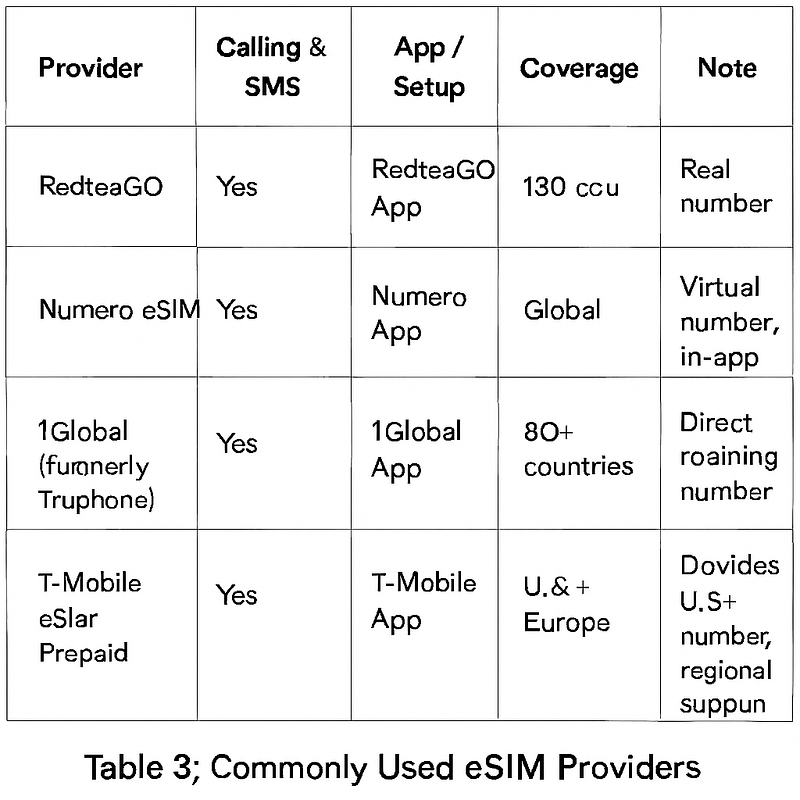
Steps for Use (Summary Guide)
1. Have an eSIM-compatible iPhone device.
2. Select a suitable service provider and download the app.
3. Purchase an eSIM package with a number through the app.
4. Register the eSIM profile on the device using a QR code or the app.
5. Enable call and SMS services to use the device for active communication.
REFERENCES
1. Information and Communication Technologies Authority (BTK) — [https://www.btk.gov.tr](https://www.btk.gov.tr)
2. Electronic Communications Law (Law No. 5809) — [https://www.mevzuat.gov.tr](https://www.mevzuat.gov.tr)
3. Apple Support Pages — Technical content for iPhone and iOS devices
4. Truphone / 1Global Official Page — [https://www.1global.com](https://www.1global.com)
5. Numero eSIM App — [https://www.numeroesim.com](https://www.numeroesim.com)
6. RedteaGO eSIM Service — [https://www.redteago.com](https://www.redteago.com)
7. MAG2SIM User Guide (Device manufacturer PDF content)
8. iOS User Guide (Apple Books — Turkish Version)
GLOSSARY OF TERMS
| Term | Description |
| — — — — — — — — — | — — — — — |
| *IMEI* | A 15-digit identification number unique to mobile devices |
| *iOS* | Apple's mobile operating system (iPhone, iPad) |
| *eSIM* | A digital SIM profile that replaces a physical SIM card |
| *Roaming* | The ability of a line to work on networks in other countries |
| *BTK* | The official institution that regulates communication infrastructure in Turkey |
| *Apple ID* | A user account that pairs devices in the Apple ecosystem |
| *QR Code* | A square-shaped data code that can be scanned with a camera |
| *Donor Device* | The source device from which the motherboard or parts are transferred
Frequently Asked Questions
What is IMEI and what does it do?
IMEI (International Mobile Equipment Identity) is a unique 15-digit identification number assigned to mobile devices. It allows devices to be recognized on cellular networks and plays a key role in security and network control.
What happens if an iPhone is not IMEI registered in Turkey?
After 120 days of first SIM activation, the device may lose access to Turkish mobile networks and function only over Wi-Fi.
How is IMEI registration done in Turkey?
Devices brought from abroad must be registered through the e-Government system within the legal time frame and the required registration fee must be paid.
Is switching to eSIM a permanent solution?
No. In certain cases, switching between physical SIM and eSIM may provide an additional temporary usage period, but it does not replace permanent IMEI registration.
Is IMEI cloning possible on iPhones?
On iOS devices, IMEI information is hardware-embedded and cryptographically linked to the motherboard. Therefore, simple cloning methods commonly associated with some Android devices are not technically applicable in the same way.
If you liked this article, you might also like my other work:
Comments
Post a Comment