Is It a Sin to Complain to Allah? A Reflection on Sustenance, Destiny, and Divine Decree
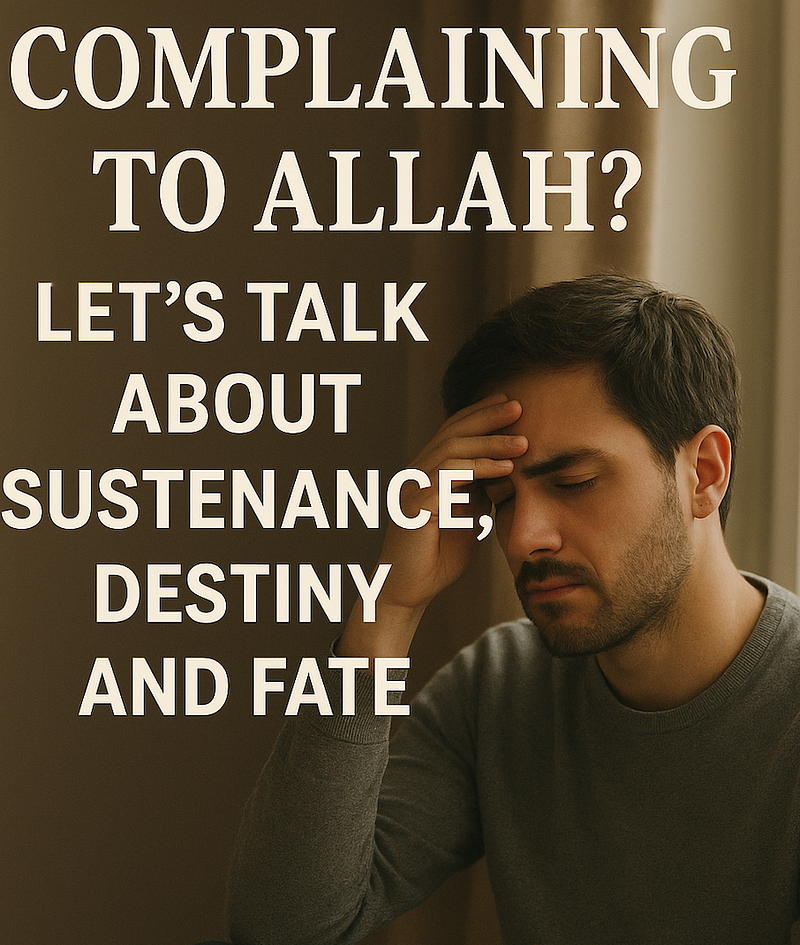
Is questioning destiny the same as rebelling against God? Is sustenance predetermined in Islam? Can a person’s final outcome change through their actions? In this article, we examine the concepts of sustenance, destiny, and fate within Islamic thought, exploring the fine line between sincere questioning and spiritual rebellion.
Hello everyone,
This article is not written in academic language, but rather in a conversational, heartfelt style. I thought this would make you feel more connected while reading.
Recently, on social media, I came across a post by a poet whom many of you know and whose poems you enjoy reading. He had written a poem, but removed it shortly after due to the reactions it received. That’s why I can’t write the entire poem here, nor do I want to mention his name. However, the content of the poem was roughly as follows:
“God, you created me, you sent me to the world. But did you ask me when you created me? Why are you now holding me accountable for what I have done? Did I want to come into this world? Did I want to be tested?”
Frankly, I was very saddened when I read these lines. Because words like these reveal both a lack of knowledge and a weakness of faith. When I asked him what these words meant to him, he said, “I’m just questioning religion.” But to me, it seemed less like questioning and more like rebellion. Today, the transformation of religious issues into a questioning centered on individual emotion is a remarkable tendency of the modern period. In my article titled "Religious Understanding Today: Formalism, Modernization and the Crisis of Meaning", where we discussed this issue in a broader framework, we evaluated similar examples. First, I want to point out that although the word “God” is used among the people, in our faith, the name of our Lord is Allah. In the Holy Quran, our Lord introduces Himself by the name ‘Allah’ and teaches us His 99 beautiful names, known as “Esmaü’l Hüsna.” We address Him with these beautiful names, and we should. We must also remember this: Before creating us, Allah decreed three things with us. These are very important matters. Let us look at them together:
1. Sustenance:
Even before we come into this world, each of our sustenances is predetermined. When, where, what we will eat, what we will earn is already known. But this sustenance does not come to us while we sit idly by. Allah has tied sustenance to work and effort. So, there is no sitting back and saying, “If it is my destiny, it will come.” We must strive and work hard. Because sustenance comes with effort.
2. Destiny (Our Spouse):
Similarly, who we will marry has also been decreed for us. But this also requires effort. To find the right person and build the right home, we must intend, pray, and take steps. You cannot just wait for destiny to come to you.
3. Whether we will go to heaven or hell:
This topic is a little different. Scholars say that sustenance and destiny cannot be changed, but whether a person will be destined for heaven or hell can be changed. How? If a person obeys Allah’s commands, does righteous deeds, repents, and lives a good life, Allah may change their destiny if He wills.
I heard a story about this that was very impressive:
There was a scholar with an open heart. One day, a man came to see him. The scholar saw in his forehead that he was destined for hell. The man left. Some time passed, and the same man came back. This time, the scholar saw that his destiny had changed; it now said he was destined for heaven. He was surprised, of course. But this shows us that a person can change through their will, their good deeds, and their devotion to Allah. Allah’s mercy is vast.
Now you might say, “What does this have to do with the poem above?”
Let me explain: If you complain to Allah as in that poem, saying, “Did you ask me when you created me?” if you question His attribute of creation, if you stay away from righteous deeds and disregard His commands and prohibitions… Yes, then the outcome is clear. This is not fate; it is your choice. Remember, God did not create you in vain. You have a purpose. God wants you to be a servant who worships Him, gives thanks, and remembers Him. This is the wisdom behind our coming into this world. Now I ask you: Did your mother and father ask you when they brought you into this world? No. Then why are you complaining to your Lord, who brought you into existence from nothing?
Of course, there is much more to say… But I don’t want to tire you with long writings. If I have touched your heart, if I have sparked a thought in you, then I am happy.
With greetings and prayers…
FREQUENTLY ASKED QUESTIONS
Is it sinful to complain to Allah?
In Islamic belief, expressions that imply rebellion against Allah’s attributes are not considered appropriate. However, sincere questions aimed at understanding faith are viewed differently.
Is sustenance predetermined in Islam?
Islam teaches that sustenance is decreed by Allah, but it is also tied to effort and work.
Can destiny change?
While certain matters are considered decreed, many scholars emphasize that a person’s actions, repentance, and righteousness can influence their ultimate outcome.
Is being destined for heaven or hell fixed?
Islamic scholars generally state that a person’s final state may change based on their faith, actions, and Allah’s mercy.
If you liked this article, you might also like my other work:
Comments
Post a Comment