Mavi Marmara Raid: Midnight Operation, Eyewitness Account, and the Burden of Memory
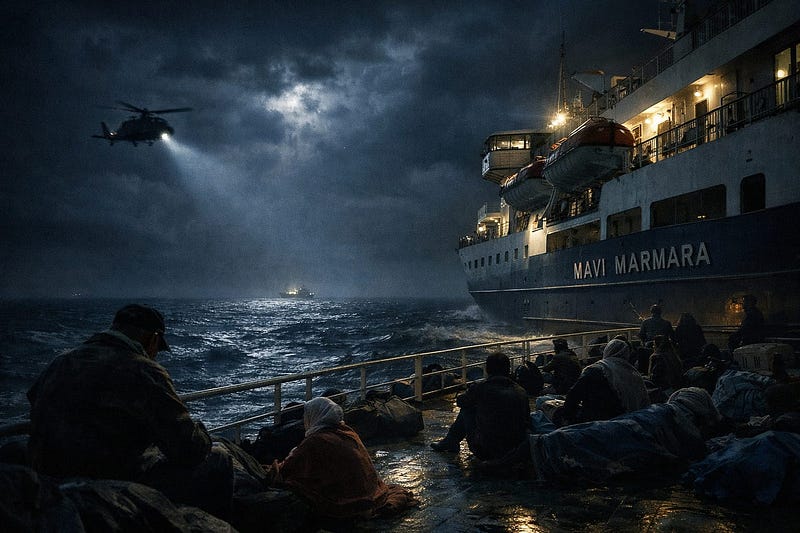
The Mavi Marmara raid in 2010 remains one of the most controversial humanitarian intervention incidents in modern history. The operation, carried out in international waters, sparked diplomatic crises and global debate. In this article, the events of that night are examined through an eyewitness narrative — focusing on fear, chaos, and the moral weight of remembrance.
It was night.
Such a dark night that the sea blended into the sky. There was no horizon. It was impossible to tell where the sea ended and where the sky began. The Mavi Marmara was moving slowly, as if it did not want to hurry; as if it knew where it was going, yet sensed that it would never reach its destination.
There were people on the deck. Some leaned their backs against the metal railings, others lay down on thin blankets spread across the floor. There were people sleeping… but it was not real sleep. Eyes were closed, yet hearts were awake. Because when a person feels that something is about to happen, they cannot truly sleep.
A man was praying quietly. His lips were moving, but no sound came out. Beside him, a young man pulled out a crumpled photograph from his pocket, trying to look at it in the darkness. The face in the photo was unclear; but from the way he looked at it, it was obvious that someone not present was very close.
There were no weapons on the ship.
There was no anger on the ship.
There was only a stubbornly carried hope.
The Moment Silence Was Shattered
Then…
First, a sound came from far away. A hum. Not the sound of the sea, nor the wind. A mechanical noise that clawed at the inside of a person. Some lifted their heads. Some stood up. “Something is coming,” someone said.
And at that moment, the sky was torn open.
The sound of helicopters collapsed onto the night. Blinding lights suddenly switched on. The deck was illuminated like daytime for an instant. People raised their hands to their eyes. Hearts began to pound against ribcages.
A scream was heard. Then another. Then the cries blended into one another. Ropes were lowered from above. And from those ropes, armed shadows began to descend.
Chaos
Everything fell apart. No one knew what to do. No one had planned for this. On a ship carrying aid, no one rehearses the question, “What if we are attacked?”
A man raised his hands and shouted, “We have no weapons!”
But his voice was swallowed by the roar of the helicopters.
Pushing and shoving began. Feet slipped on the metal deck. Some fell. Others tried to lift them up. In that chaos, the rawest state of humanity emerged: fear, helplessness, and yet at the same time, the instinct to protect another.
Then…
A sound.
A gunshot.
When the first bullet was fired, time slowed down. The human mind refuses to believe it. There is a feeling that says, “This should not be happening.” But then a second shot comes. A third… And denial ends.
A man clutched his chest. Another fell to his knees. A woman screamed — a scream not only from her throat, but from deep within. Blood spread across the deck. The salt of the sea, the cold of metal, and the smell of gunpowder mixed together.
A Test of Humanity
There were people trying to carry the wounded. Voices saying, “Hold on, hold on…” But some bodies no longer responded.
A man was lying on the ground. His eyes were open. He was staring at the sky. The helicopter light passed over his face. No one knows what he was thinking at that moment. Maybe his home. Maybe his mother. Or perhaps the question, “Was this worth it?”
Time lost its meaning. Minutes or seconds — no one knew.
Eventually, the gunfire stopped.
But the silence…
That silence was the kind that makes one’s ears ring.
Aftermath
There were those who remained on the deck.
And those who did not.
Some were crying. Quietly. Some were frozen in place. Some still felt they had to do something but did not know what.
The ship changed course.
Not toward Gaza.
Toward somewhere else.
That night, the sea saw everything.
But the sea does not speak.
Those who speak are the memories of those left behind.
The Weight of Memory
I survived that ship.
But sometimes I am not sure… did I really survive?
Years passed. Calendar pages turned, the news grew old, people became accustomed to other pains. But whenever I wake up at night, I am still on that deck. The cold of the metal on my back, the salt of the sea on my lips, a constant hum ringing in my ears…
I was not sleeping that night. And who could truly sleep anyway? My eyes may have been closed, but there was an unease inside me. My heart was saying, “Be ready,” but I did not know what I was supposed to be ready for.
Then that sound came. First distant, then closer. And suddenly, the fear collapsed into my chest. The sound of helicopters. When the lights fell on us, I covered my face with my hand. My eyes burned. My heart was racing. I stood up. On everyone’s face was the same expression: “This should not be happening.”
But it did.
Armed shadows descended. I wanted to shout, “We have no weapons.”
Maybe I did shout… I don’t remember.
A scream.
A fall.
Then a gunshot.
When I heard the first bullet, my knees trembled. Facing reality can sometimes hurt more than a bullet.
I saw someone fall to the ground. I ran to him. His eyes were open. I did not know his name, but I will never forget his face. There was no fear in his eyes. There was confusion. I pressed my hand against his chest. The blood would not stop. I said, “Hold on.” Maybe I was saying it to myself.
It was like hell around us.
And yet there was also a strange silence.
This, I learned, is what trauma feels like.
For a moment, I thought about death.
Not with fear, but with incompleteness.
My mother came to my mind.
“What would happen if she received this news now?” I thought.
That thought burned more than the bullet.
Remembering
The gunfire stopped. But the noise inside me did not. The ship felt as if it had stopped, but time kept moving. I looked at those lying on the ground. Some were still warm. Some had begun to grow cold. That coldness has never left my hands.
They gathered us together. Our heads were lowered. No one spoke. The ship changed course. The sea was the same, but we were now going somewhere else.
That was when I understood:
We had not reached Gaza.
But Gaza had reached us — with its pain, its helplessness, its loss.
I was alive.
But after that night, nothing was ever the same.
When I hear the sound of a helicopter in a crowd, my chest tightens. When I look at the sea at night, my eyes fill with tears. Sometimes I try to fall asleep by listening to someone’s breathing. Because there is one thing I learned on that ship:
A person clings to life as long as they can hear another person breathe.
I survived.
But on some nights… I wish I did not remember this much.
And then I feel ashamed.
Because remembering is a debt to those who did not return.
And Now…
The pen stops.
The words slow down.
Because now is not the time to speak, but to remember in silence.
There are names that remained on that deck.
But they were not just names.
They were a mother’s son, a child’s father, the light of a home:
Cevdet Kılıçlar
Çetin Topçuoğlu
Furkan Doğan
İbrahim Bilgen
Necdet Yıldırım
Ali Haydar Bengi
Fehmi Yıldırım
Hasan Hüseyin Can
Mehmet Nuri Aydın
And the one who clung to life for days between life and death, then left us: Ahmet Polat
They did not return that night.
But their names did.
To memories.
To prayers.
To consciences.
The sea may have fallen silent.
The world may have moved on to other agendas.
But on some nights, the same question still echoes within us:
“Was all this loss for this much silence?”
What falls to us is this:
Not to forget.
Not to let it be forgotten.
For those who want to understand how social memory is shaped and suppressed, The Headscarf Ban in Turkey: Freedom, Identity, and the Symbolism of Don't Cry, Carnation looks at this issue from a different perspective.
And to keep our hearts a little more open each time their names are spoken.
I ask God to grant them mercy.
May their resting place be heaven.
Patience to those left behind…
And to us, a humanity worthy of carrying their names.
Because some people do not die.
They become names.
And names continue to live
as long as conscience lives.
FREQUENTLY ASKED QUESTIONS
When did the Mavi Marmara incident occur?
The raid took place on May 31, 2010.
Where did the operation happen?
The intervention occurred in international waters according to widely cited international reports.
What was the purpose of the ship?
It was part of a humanitarian aid flotilla heading to Gaza.
Why is the incident still discussed today?
Because it raised major questions regarding international law, human rights, and state accountability.
If you liked this article, you might also like my other work:
Comments
Post a Comment